



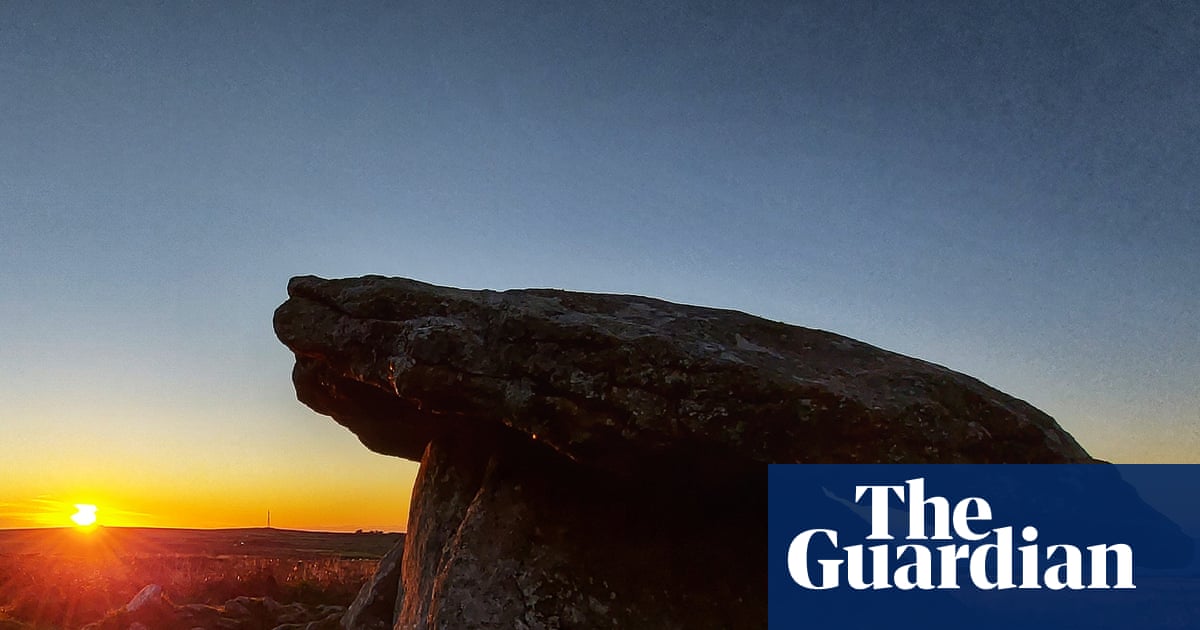
The Enchantment of the Winter Solstice in West Cornwall
The fading light casts a mystical ambiance as I find myself enveloped by the ancient Tregeseal stone circle near St Just. The granite stones rise like glowing phantoms, a silent audience to the stories of the past. Above, the barren landscape is breached only by the imposing Carn Kenidjack, a formidable rock formation that seems to guard the horizon. As night descends, local lore speaks of pixies and demons, adding a layer of intrigue and eeriness to this historic site.
A Glimpse into the Past
As I stand there with my companion, archaeoastronomer Carolyn Kennett, we gaze towards the distant Isles of Scilly, mere smudges on the horizon. Suddenly, the clouds part, and a cascade of golden light spills over the islands—an awe-inspiring spectacle that would have been witnessed by the ancient builders of this stone circle 4,000 years ago.
Our conversation naturally gravitates towards the winter solstice. Carolyn emphasizes that the entire Land’s End peninsula can be viewed as an ancient landscape designed for solstice observation. She points out that the granite spine running southwest aligns perfectly with the midwinter sunset.
- Standing at Chûn Quoit during the winter solstice offers a direct view of the sun setting behind Carn Kenidjack.
- This alignment likely reflects the intentions of the Neolithic builders.
The Symbolism of Tregeseal
Carolyn proposes that Tregeseal was strategically positioned to allow its creators to witness the midwinter sun setting over the Isles of Scilly. She describes Scilly as a “liminal space,” where visibility fluctuates with the whims of weather—some days appearing near and vibrant, while on others, they vanish entirely. This duality may have given the circle builders a sense of connection to the supernatural, making it a site for winter solstice rituals and reflections on death and rebirth.
“Where better to celebrate the return of the light than on the Land’s End peninsula, which points towards the setting point of the sun on the year’s shortest day?”
A Journey Through Time
As we navigate through the darkening moor, past ancient burial mounds and remnants of mining, we arrive at a fascinating monument—perhaps the UK’s only ancient row of holed stones. Unlike its more famous counterpart, Mên-an-Tol, these stones offer small holes that are not traversable, leaving archaeologists puzzled.
Carolyn theorizes that this arrangement may have served as a kind of countdown calendar to the winter solstice, with sunlight piercing through the holes to create unique light patterns as the days shortened in autumn. This experience, she suggests, vividly connects us to how ancient peoples might have perceived the significance of the solstice.
The Importance of Celestial Alignment
The prevalence of ancient sites aligned with solar events at midwinter and midsummer suggests a deep-seated cultural significance. Just as our prehistoric predecessors tracked the sun’s movement for agricultural purposes, so too do we feel the weight of darkness today, welcoming the winter solstice as a pivotal moment before the days begin to lengthen once more.
“A wild night of misrule”—Morris describes Montol, a midwinter festival celebrating the return of light, filled with music, costumes, and tradition.
Festivities and Traditions
This December 21st, communities across West Penwith will come together to honor the winter solstice by gathering at various ancient sites. Carolyn will lead a walk to Chûn Quoit, while filmmaker Christopher Morris will visit the Boscawen-Ros stone, continuing his personal ritual of reflection and renewal. Later, the streets of Penzance will fill with revelers for Montol, a festival that, although revived only in 2007, echoes ancient Cornish customs of dancing, music, and merriment.
- Penzance’s Montol celebrates with guise dancing, traditional caroling, and lively music.
- Revellers will don masks and engage in boisterous activities, including the symbolic burning of a sun effigy.
- The festivities culminate in a torch-lit procession to the sea, marking the joyous return of the light.
Conclusion
In the enchanting realm of West Penwith, where folklore and community rituals intertwine with ancient stones, the spirit of the winter solstice thrives. This time of year serves not only as a celebration of light returning but also as a poignant reminder of the cycles of nature and our place within it.
Fiona Robertson is the author of Stone Lands, published by Robinson at £25.
For more details, read the original news article here.