



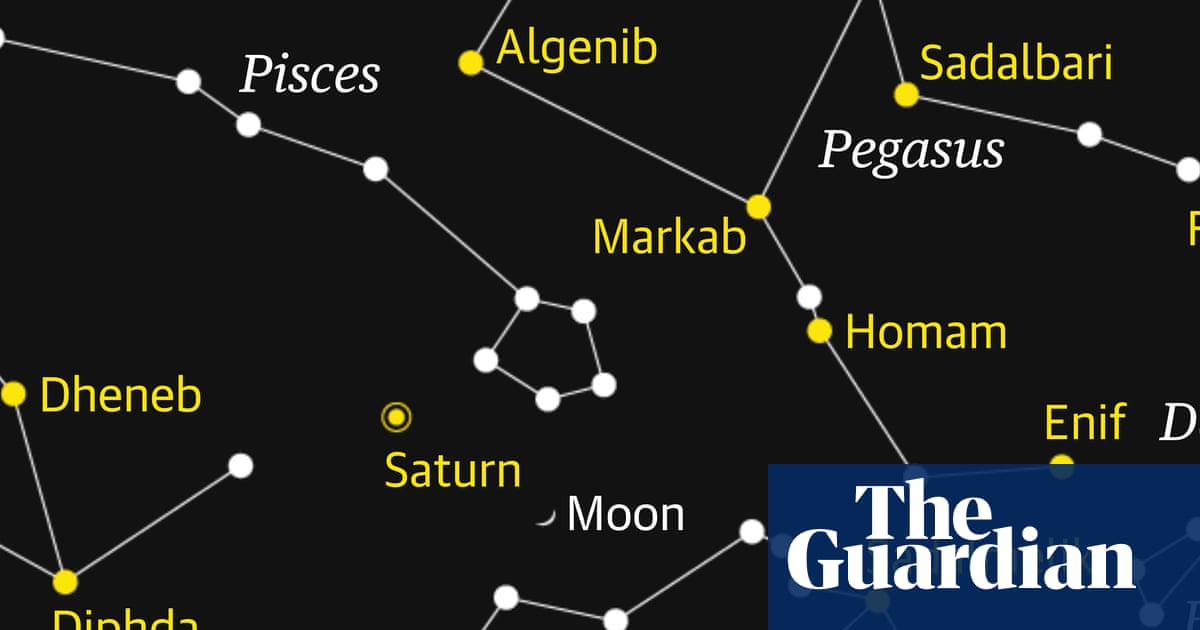
The Celestial Dance: Moon Meets Saturn
In an enchanting display of cosmic beauty, a slender crescent moon will glide past Saturn this week, providing an extraordinary opportunity for stargazers. As evening twilight fades into the deep embrace of night, this conjunction invites us to pause for a moment of quiet reflection beneath the vast expanse of the sky.
Viewing the Conjunction
The ideal vantage point for this celestial event is looking south-west from London at around 18:00 GMT, although the pairing will be visible from the onset of dusk. Here are a few key details to enhance your viewing experience:
- Moon Age: The moon will be just under four days old, displaying a delicate crescent.
- Illumination: With only 15% of its surface illuminated, observers will have a chance to witness the phenomenon known as “Earthshine.” This occurs when sunlight reflects off our planet onto the moon, subtly illuminating its darkened surface.
- Saturn’s Appearance: Saturn will shine as a steady, creamy point of light in the sky, contrasting with the twinkling stars that will emerge as darkness settles.
The Science Behind the Beauty
Understanding why Saturn maintains a steady glow while stars twinkle is rooted in the physics of light and atmosphere. Stars, located at extreme distances, appear as mere points of light. The Earth’s atmosphere causes fluctuations in their visibility, resulting in that characteristic twinkling effect. In contrast, planets like Saturn appear as tiny discs, which helps to average out atmospheric disturbances, giving them a steadier appearance.
A Global Phenomenon
This conjunction is not limited to observers in the northern hemisphere; it can also be easily seen from the southern hemisphere. This universal visibility underscores the shared experience of wonder that celestial events can bring, connecting us all under the same sky.
As we prepare to gaze upward, let us embrace the beauty and serenity that such moments provide—an opportunity to reconnect with the universe and reflect on our place within it.
For those looking for more details on this celestial event, I encourage you to read the original news article here.